![]() Section1
Section1
![]() Navigation Main
Navigation Main
VIB: Pre-tax Profit Reaches Over VND 5,180 Billion, Total Assets Surpass VND 580 Trillion in H1 2026
27/07/2026
Ho Chi Minh City – Vietnam International Bank (VIB) announced its business results for the first six months of 2026, with pre-tax profit reaching over VND 5,180 billion, up 3% year-on-year. Amid continued competition in interest rates and credit in the financial market, VIB maintained growth on a foundation of financial safety, improved asset quality, and stable operating efficiency.
As of June 30, 2026, VIB's total assets exceeded VND 580 trillion, up 4% from the beginning of the year. Customer deposits reached over VND 317 trillion, up 8%, while outstanding credit balance reached over VND 397 trillion, up 4%.
Positive Capital Mobilization Growth, Improved Asset Quality, Safety Ratios Maintained at Optimal Levels
As of June 30, 2026, VIB's total assets reached over VND 580 trillion, up 4% from the start of the year. Deposit mobilization reached over VND 317 trillion, up 8%, providing a solid foundation for the bank to expand its business and meet customers' credit demands. Notably, low-cost funding sources – including current account savings account (CASA) deposits and foreign currency deposits – accounted for 19% of total customer deposits, helping to support net interest margin amid ongoing market volatility.
By the end of June 2026, the bank's outstanding credit balance reached over VND 397 trillion, up 4% from the beginning of the year. The credit portfolio continued to develop under a diversification strategy, with the retail and small-and-medium enterprise (SME) segments remaining the core drivers, accounting for 67% of total outstanding loans. At the same time, corporate customer loans grew 22% and loans to financial institutions grew 11%, reflecting a selective expansion strategy into potential segments while maintaining balance in the credit structure.
One of the notable highlights of the first half was continued improvement in asset quality. The non-performing loan (NPL) ratio fell to 2.10%, down 6 basis points from the start of the year, demonstrating the effectiveness of risk management, credit control, and debt recovery efforts. Maintaining asset quality amid continued credit expansion is an important foundation for the bank's sustainable development over the medium and long term.
Safety ratios remained at optimal levels: the Capital Adequacy Ratio (CAR) under Basel II reached nearly 12% (regulatory requirement: above 8%); the Loan-to-Deposit Ratio (LDR) stood at 79% (regulatory requirement: below 85%); the ratio of short-term funding used for medium- and long-term loans was 28% (regulatory requirement: below 30%); and the Net Stable Funding Ratio (NSFR) under Basel III reached 103% (Basel III standard: above 100%). All four ratios remained within regulatory safety thresholds.
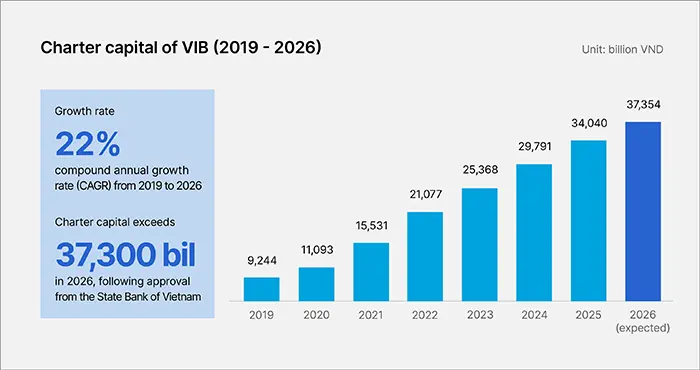
Approved to Increase Charter Capital to Over VND 37,300 Billion, Strengthening Financial Capacity
On June 24, 2026, VIB received approval from the State Bank of Vietnam for a plan to increase charter capital to over VND 37,300 billion, further strengthening the bank's financial capacity and headroom for business expansion in the coming period. This marks another in a series of consecutive charter capital increases for VIB in recent years, with a compound annual growth rate (CAGR) of over 22% during the 2019–2026 period, significantly expanding the bank's charter capital scale compared to previous years.
This strengthened capital base gives VIB more room to boost credit issuance, invest in technology infrastructure, and expand its business network, while maintaining optimal operational safety ratios as required, even as the bank continues to expand its total assets and credit scale.
Positive Business Performance, Continued Recognition from Reputable Organizations
In the first six months of 2026, VIB's total operating income (TOI) reached over VND 11,220 billion, up 16% year-on-year, while pre-tax profit reached over VND 5,180 billion, up 3% year-on-year. At the same time, VIB proactively strengthened its provisioning buffer, in line with its orientation toward safe growth and prudent risk management. Despite continued competitive interest rate conditions, the bank maintained a net interest margin (NIM) of 3.1%, reflecting effective management of funding costs and optimization of the earning asset structure.
The revenue structure continued to diversify, with non-interest income accounting for 22% of total operating income, driven by positive contributions from bancassurance, credit cards, and recovery of previously written-off debts. Effective cost control brought the cost-to-income ratio (CIR) down to 34%. Credit cost was maintained at 1.2%, while return on equity (ROE) reached 16%.
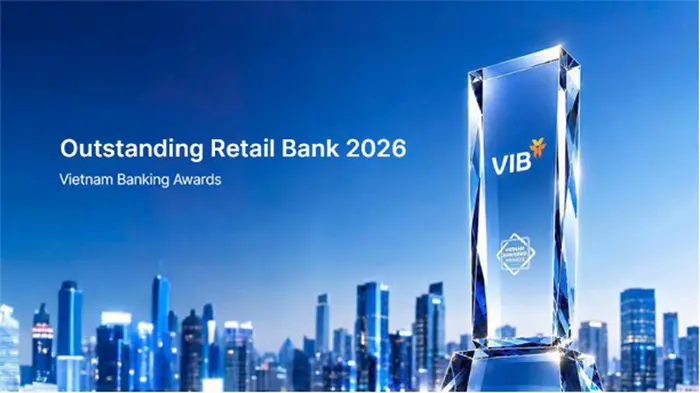
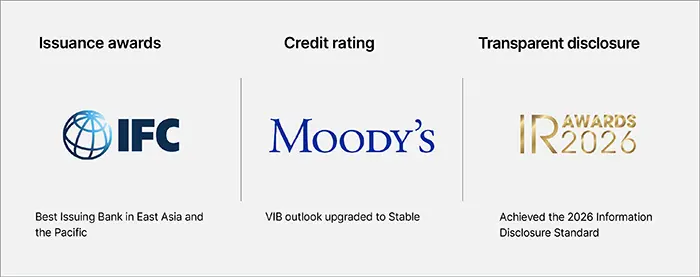
VIB's financial capacity, governance quality, and transparency continued to be recognized by reputable domestic and international organizations. During the period, Moody's upgraded VIB's credit rating outlook to Stable; IFC honored VIB as the "Outstanding Issuing Bank in the East Asia and Pacific Region"; and the bank also achieved the 2026 Information Disclosure Standard under the IR Awards Program. These accolades help reinforce VIB's market reputation while strengthening the trust of customers, partners, and investors.
Expanding the Financial Solutions Ecosystem Toward Personalization
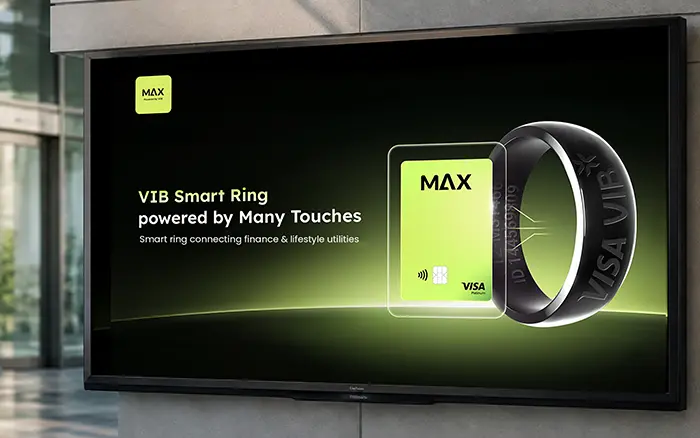
In the credit card segment, VIB continued to maintain a prominent position with nearly 1.2 million cards in force, while total card spending in the first half of 2026 reached over USD 2.6 billion. Notably, the Max Card recorded nearly 80,000 cards issued in just under four months since launch, an early indication of positive market reception for the membership-package credit card model. The product allows customers to actively select the benefit tier that suits their spending needs, thereby personalizing the experience and optimizing the value of benefits on a single card.
Building on the membership-package model introduced through Max Card, VIB extended this approach from card spending to customers' entire personal financial journey with VIB Up. The solution is designed with three benefit tiers – Plus, Pro, and Elite – connecting needs around cash flow management, savings accumulation, borrowing, spending, and priority banking services. Through this, VIB is gradually shifting from providing individual products to building needs-based financial solutions, helping to increase multi-product usage and deepen customer engagement.

The first-half 2026 business results show that VIB continues to pursue a development strategy that pairs growth with quality, prioritizing risk management, strengthening financial capacity, and continuously innovating the customer experience. With a solid capital foundation, improved asset quality, and an increasingly comprehensive product ecosystem, VIB is well-positioned to enter the second half of the year with new growth momentum, aiming for sustainable growth and continued value creation for customers, shareholders, and the economy.